
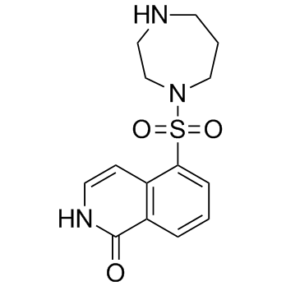
| CAS NO: | 105628-72-6 |
| 规格: | ≥98% |
| 包装 | 价格(元) |
| 5mg | 询价 |
| 10mg | 询价 |
| 25mg | 询价 |
| 50mg | 询价 |
| 100mg | 询价 |
| 250mg | 询价 |
| Molecular Weight (MW) | 307.37 |
|---|---|
| Formula | C14H17N3O3S |
| CAS No. | 155558-32-0 (HCl salt); 105628-72-6 (free) |
| Storage | -20℃ for 3 years in powder form |
| -80℃ for 2 years in solvent | |
| Solubility (In vitro) | DMSO: 68 mg/mL (197.8 mM) |
| Water: 68 mg/mL (197.8 mM) | |
| Ethanol: <1 mg/mL | |
| SMILES | O=C1NC=CC2=C1C=CC=C2S(=O)(N3CCNCCC3)=O |
| Synonyms | HA-1100; HA 1100; HA1100; HA-1100 HCl |
| In Vitro | In vitro activity: Fasudil (1-10 μM) and hydroxyfasudil (0.3-10 μM) significantly prevented endothelin-induced cardiomyocyte hypertrophy. Hydroxyfasudil significantly attenuated serotonin (IC)-induced vasoconstriction of SA (-7 +/- 1% vs. 2 +/- 1%, p < 0.01). Coronary I/R significantly impaired coronary vasodilation to acetylcholine after I/R (SA, p < 0.05; and A, p < 0.01 vs. before I/R) and L-NMMA further reduced the vasodilation, whereas hydroxyfasudil completely preserved the responses. Kinase Assay: Hydroxyfasudil HCl (also called HA1100 HCl), a metabolite of Fasudil, is a potent Rho-kinase inhibitor and vasodilator. It acts as a ROCK inhibitor, with IC50s of 0.73 and 0.72 μM for ROCK1 and ROCK2, respectively. Hydroxyfasudil prevents the downregulation of endothelial NO synthase (eNOS) under hypoxic conditions. In a concentration-dependent manner, hydroxyfasudil increases eNOS mRNA and protein expression, resulting in a 1.9- and 1.6-fold increase, respectively, at 10 μmol/L. This correlates with a 1.5- and 2.3-fold increase in eNOS activity and NO production, respectively. Cell Assay: Human vascular endothelial cells are treated with increasing concentrations of hydroxyfasudil (0.1 to 100 μmol/L) and eNOS expression and activity are measured. |
|---|---|
| In Vivo | Intracoronary administration of hydroxyfasudil(HF) causes a significant coronary vasodilation of both small arteries and arterioles in a dose-dependent manner under control conditions with a resultant increase in CBF(coronary blood flow). Intracoronary hydroxyfasudil does not significantly alter mean aortic pressure or heart rate. Pretreatment with hydroxyfasudil markedly reduces the I/R-induced myocardial infarct size, and this beneficial effect of hydroxyfasudil is significantly attenuated by L-NMMA. NO may be involved in those cardiovascular protective effects of hydroxyfasudil. Hydroxyfasudil may also be effective for the treatment of pulmonary hypertension. HF protects the myocardium subjected to pacing-induced ischaemia through the increase in the regional myocardial blood flow. |
| Animal model | Mongrel dogs |
| Formulation & Dosage | Dissolved in saline; 10, 30, and 100 μg/kg; Intracoronary administration |
| References | Stroke. 2005 Oct;36(10):2251-7; J Am Coll Cardiol. 2005 Feb 15;45(4):599-607; Br J Pharmacol. 2001 Dec;134(8):1724-30. |
| 维奥蛋白资源库 - 中文蛋白资源 CopyRight © 2010-2026 |